How to Mix and Match Cushions on a Sofa Like a Stylist
A sofa with no cushions looks like a bed with no duvet: functional, slightly bare, and quietly unfinished. Add the right ones and the whole room shifts — warmer, more layered, more deliberate. Add the wrong ones and it looks like a jumble sale happened in your front room.
The good news is that stylists aren't working from secret knowledge. They're just making the same handful of decisions in a sensible order: colour first, then size, then pattern, then texture. Follow that sequence and the arrangement practically styles itself.
Start with a colour story, not a pattern
Pattern is the enjoyable part, which is why most people begin there and end up stuck with a pile of beautiful cushions that don't speak to each other. Colour is easier to control, so begin there.
Pick three colours and no more. One base, one mid-tone, one accent. The base is usually a neutral that matches the sofa or sits close to it — oatmeal, stone, warm grey, soft charcoal. The mid-tone is where personality arrives: sage, navy, clay, dusty rose. The accent is the small hit that wakes everything up: mustard, rust, forest green, black.
For a rough balance, think of it as roughly six parts base, three parts mid-tone, one part accent. So on a five-cushion sofa that might be three plain or subtly textured cushions in the base colour, one patterned cushion that mixes base and mid-tone, and one punchy accent cushion.
Anchor the palette to something already in the room. If your rug has rust in it, or your curtains carry a green undertone, borrow from it. That single decision is what makes an arrangement look as though it belongs rather than arrived.
Work in odd numbers and vary the sizes
Three, five or seven cushions usually read better than two, four or six. Odd numbers create a natural focal point in the middle; even numbers invite your eye to pair things up and hunt for symmetry that isn't quite there.
Size matters as much as quantity, and this is where a lot of sofas go wrong:
- Large squares, 55–60cm: the backbone. Two of these in the back corners of a three-seater give the arrangement its height.
- Medium squares, 45cm: the middle layer. These sit in front of and slightly between the large ones.
- Rectangular lumbar cushions, roughly 30 x 50cm: the finishing layer. One or two at the front, off-centre, breaks up the square shapes.
- Round or bolster cushions: optional, but excellent for softening a very angular sofa.
A two-seater wants three cushions; a three-seater handles five comfortably; a corner sofa works best with cushions gathered into clusters of three at each end or corner rather than spread thinly along the whole thing. If your sofa is small, stay at 45cm or under — oversized cushions on a compact sofa make the furniture look smaller, not more generous.
Mix pattern by scale, not by theme
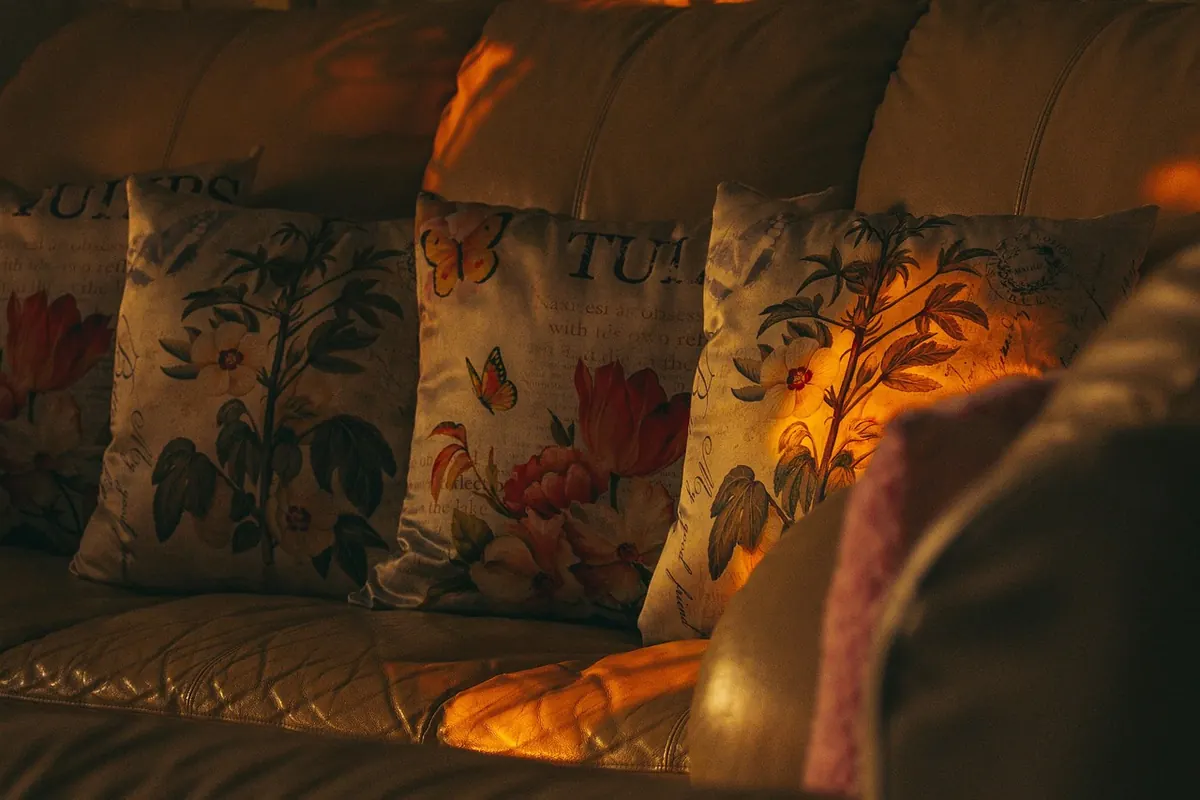
The reliable rule for combining prints is to vary the scale. One large, bold pattern, one small or dense pattern, and one plain or subtly textured cushion. Two large patterns side by side compete; a large floral next to a fine stripe next to a plain velvet looks confident and intentional.
Limit yourself to three patterns per sofa. Two florals will fight unless one is tiny and the other is enormous — and even then it's a gamble. Colour is what ties different motifs together, so make sure every patterned cushion shares at least one colour with the palette you chose earlier.
Stripes are the easiest pattern to work with, because they behave almost like a solid: they read as colour from a distance. Geometrics and small repeating motifs work the same way. A large painterly floral or an oversized ikat needs more empty space around it, which is why it belongs next to plains.
Texture does half the work
Two cushions in the same colour but different fabrics will look richer than two in different colours but the same fabric. Build a mix: linen or washed cotton for a relaxed feel, velvet for depth, bouclé or wool for weight, a cotton canvas for crispness.
If everything on your sofa is smooth, it will look flat. If everything is chunky and textural, it will look heavy. Aim for one tactile cushion — a bouclé, a chunky knit, a velvet with a sheen — for every two smoother ones.
Trim is a quiet tool. Piping, fringing or a tasselled edge adds definition, but keep it to one trimmed cushion per arrangement. More than that and the sofa starts to look busy rather than layered.
A formula you can copy
If you'd rather not think it through from scratch, use this as your starting point for a three-seater:
- Two large square cushions in your base colour, one in each back corner. Plain linen or cotton works well.
- One medium cushion with your main pattern, showing base plus mid-tone. Place it slightly left or right of centre.
- One medium cushion in a solid mid-tone or a second pattern at a much smaller scale. Place it on the opposite side.
- One small accent cushion in your boldest colour, positioned in front and off-centre.
- Optional extra: one lumbar cushion in a textural neutral across the front.
Then adjust by eye rather than rule. Slide the accent cushion a few centimetres left. Swap the two medium cushions over. Small moves change the whole balance, and you'll know when it clicks.
Finishing touches that make it look styled
Fill matters as much as fabric. A cushion pad roughly 2cm larger than its cover gives a full, plump shape; an undersized pad leaves corners drooping and the whole sofa looking tired. Feather and down pads give that soft, sink-in look, while synthetic pads hold a crisper shape — good for geometrics and anything with a strong print.
Plump cushions properly by holding them at the corners and pulling the pad back into shape, then pressing the air out from the middle. A gentle chop across the top of a cushion softens the line and stops the arrangement looking rigid. And once a month, rotate the cushions — turn them over, swap positions — so the ones near the window or under a lamp don't fade unevenly.
Start with what you already own
Before buying anything, empty the sofa and lay every cushion you own on the floor. Sort them into base, mid-tone and accent, then put back only what fits the palette. Most people find they already have three-quarters of an arrangement hiding in a cupboard, and removing the odd ones out does more for the room than adding more.
Then buy one thing at a time. Add a cushion, live with it for a week, and see whether the sofa needs something lighter, darker or larger before you commit to the next. Cushions are the cheapest way to change a room, which means you can afford to be a little experimental — and unlike paint, you can change your mind on a Sunday afternoon.
Photo: Rattakarn_ / Pixabay